
Curved Monitor vs Flat: Which One Should You Choose?
In modern office, design, and entertainment environments, monitors are no longer just tools for displaying information, they have become essential devices for enhancing efficiency and user experience. As a professional monitor manufacturer, we often receive inquiries from businesses and professional users asking: Curved monitor vs flat monitor, which one is better suited for different applications?
In fact, whether it’s for an immersive gaming setup, color-accurate design work, or a productivity-focused office environment, understanding the key differences between the two is crucial. In this article, we’ll compare curved and flat monitors from multiple perspectives to help both enterprise and individual customers make more informed and cost-effective purchasing decisions.
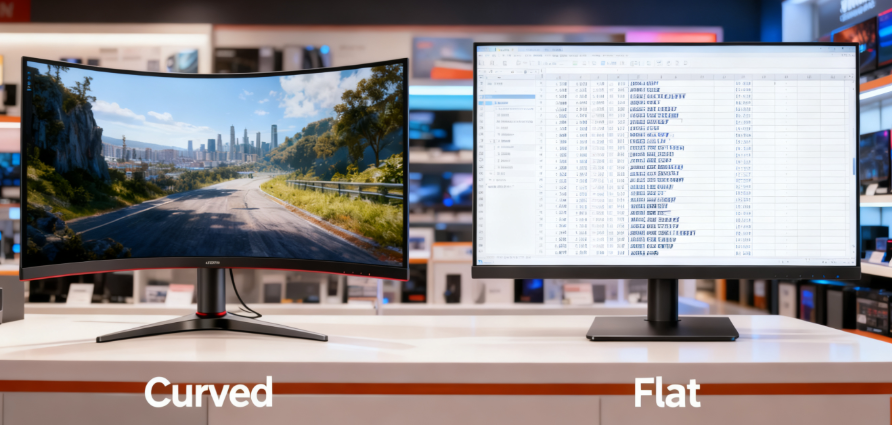
Appearance and Design Overview: From Flat to Curved
Curved monitors feature a curved-in screen, usually expressed as a “curvature radius,” such as 1500R or 1800R. The smaller the number, the sharper the curve.
This model is premised on the natural eye curvature of a human being, placing the point of sight closer to the screen’s center and reducing edge distortion to create a more immersive experience.
Curved monitors are particularly suitable for gamers, movie lovers, and designers or image processing experts who require a lot of immersion.
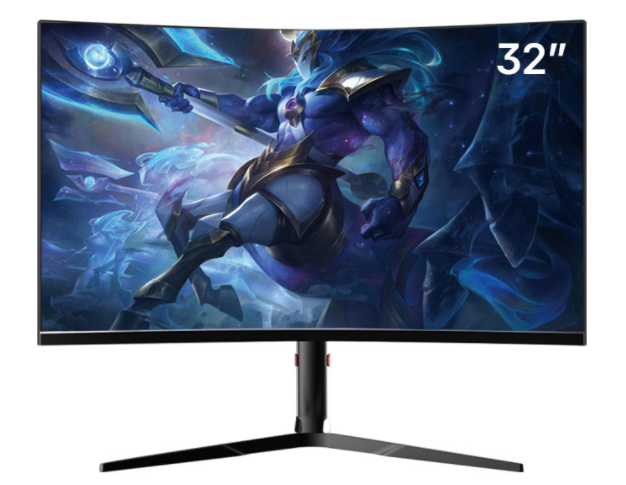
Flat monitors have a typical flat-panel form factor. After decades of technology refinement, they are quite mature, wide in compatibility, and easy to set up and position.
Flat screens work well in multi-monitor setups, office environments, or commercial image work that needs color reproduction. Flat screens are also widely less costly and still the most common type of monitor out there.
Visual Experience and Immersion: Enveloping View vs. Accurate Reproduction
For gamers and movie enthusiasts, immersion is often the top priority.
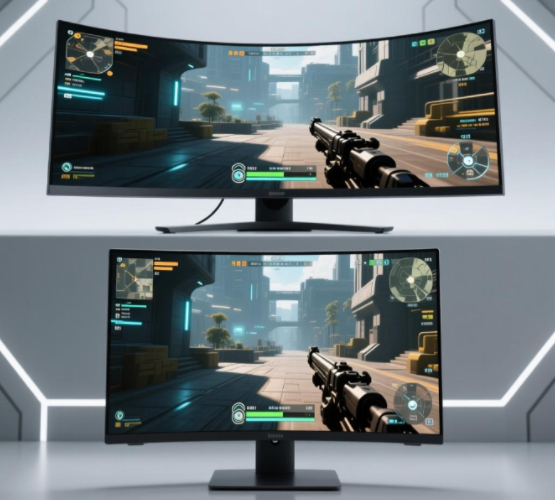
Curved monitors, due to their curved shape, sweep the edges of the image in the direction of the viewer’s line of view, reducing edge distortion and creating a “wrap-around” visual experience. This sense of immersion is most evident in racing, shooting, and simulation games.
Flat screens are superior to curved screens at presenting images as realistically as possible, uncorrupted by distortion generated by reflections of light, and thus more appropriate for users demanding high visual fidelity, i.e., designers, photographers, and video editors.
In short, if you desire an interactive entertainment experience, a curved screen is better; but if your line of work requires precise image and color representation, a flat screen is better.
Ergonomics and Visual Comfort
Eyes are especially important when one spends extended amounts of time with a monitor.
Studies have revealed that curved monitors are nearer to the natural form of the human eye, reducing focal compensation in viewing screen edges and hence optical fatigue. Distortion at the edges and glare are also reduced with the curved form, which makes extended one-on-one sessions such as gaming or coding more comfortable.
Flat monitors, however, offer an equal viewing angle to the whole screen, which is convenient when content is being shared or read by several individuals at once. Additionally, flat screens are more natural to use for vertical activities like reading, document editing, or coding without any geometrical distortion.
In summary:
- For prolonged solo use for hours, such as gaming or coding, curved screens are more comfortable.
- For common work or repeated screen sharing, flat screens are handier and more practical.
Performance Among Different Usage of Curved vs Flat
Gamers’ Experience
When the monitor is made specifically for gamers, a curved monitor is used. Their wrapping nature gives a greater gaming experience, especially for racing games, shooting games, and role-playing games. High refresh rates (165Hz and above) and less latency in certain top-end curved monitors also offer greater gameplay.
Flat screens, nevertheless, offer constant response time and true image reproduction, which may be superior for aggressive gamers, such as those playing FPS games.
Office and Productivity
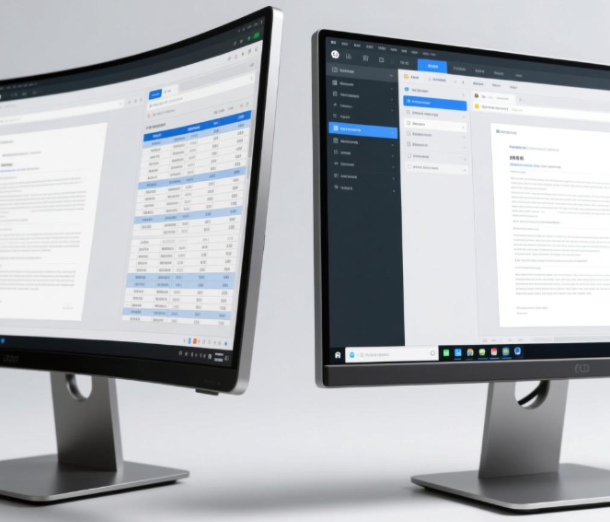
For office application, flat monitors remain the mainstream choice. Flat monitors are inexpensive, display text clearly, and are easy to set up in multi-monitor configurations. Curved screens can also prove useful for multitasking, as their shape can reduce eye movement when working with multiple open windows.
Design and Creative Work
Designers, photographers, and video editors prefer flat screens since they display colors exactly as they appear and preserve geometric integrity. While curved screens look great visually, even a subtle curve of the edges will affect the perceived straightness of lines.
Entertainment and Multimedia
Curved screens present a cinematic, panoramic viewing experience with wide viewing angles when it comes to movie or video watching.
Price, Size, and Maintenance Comparison
Price
Flat monitors are certainly less expensive. Their production method is set and huge volume production keeps overall prices low. Even high-refresh-rate or high-resolution models offer more bang for the buck.
Curved monitors, through more complex manufacture and tighter material requirements, cost more, especially ultra-wides.
Size Options
Curved monitors are best suited for larger screens, typically 27 inches and above, where one can experience the curvature. Flat monitors vary from 21 inches up to 49 inches, providing greater flexibility for different setups.
Maintenance and Setup
Flat monitors are simpler in design and have more compatible stands, making them easier to wall-mount or replace. Curved monitors require more careful angle and stand compatibility consideration when mounting to provide the optimal view.
Comparison Table of Pros and Cons of Curved vs Flat Monitor
Beyond their differences, it’s essential to understand the strengths and weaknesses of both curved and flat monitors before making the final decision.
The following table summarizes these key points of curved monitors and flat monitors pros and cons.
| Feature | Curved Monitor | Flat Monitor | Business Reference |
| Immersion | Excellent | Moderate | Showrooms, multimedia experiences, training rooms |
| Visual Comfort | Relatively High | Moderate | Office work, long-duration use |
| Image Accuracy | Slight edge distortion | Precise and stable | Design, video editing, control centers |
| Recommended Size | 27 inches and above | Any size | Depending on space planning and budget |
| Price Range | Slightly higher | More affordable | Bulk procurement may allow negotiation |
| Installation & Maintenance | Slightly more complex | Simple and convenient | Consider stand and space compatibility |
Note: The Business Reference column is for business buying scenarios; individual customers can disregard it.
Curve Monitor vs Flat: Which One to Choose?
Now that you know the key differences between curved and flat monitors, the next question is — which one should you choose? To make things easier, we’ve summarized the best options for individual users and corporate users below.
Individual Users
Gamers or Multimedia Enthusiasts: Curved screens are ideal for immersive gaming or cinematic experiences, with wrap-around view and increased visual engagement.
Office Work, Design, or Video Editing: Flat screens are ideal for applications that demand precise color representation and geometric accuracy, with consistent and reliable image reproduction.
Corporate Users
Flat or curved monitors can serve for bulk orders, showrooms, or training programs depending on the situation. Direct sourcing from producers is advised to ensure product stability, uniform quality, and affordable after-sales services.
The approach fulfills immersion, productivity, and cost-effectiveness demands depending on the application and user needs.
Tenfly: Direct Supply from Professional Monitor Manufacturer
As a professional manufacturer of monitors, Tenfly specializes in custom solutions of curved and flat monitors, both accommodating corporate bulk orders and OEM/ODM customization. To work with Tenfly directly is advantageous for companies in many ways:
Stringent Quality Management: All of the monitors undergo rigorous quality control to guarantee stable performance and long-term stability.
Variety of Size and Curvatures: Tenfly offers various screen sizes and curvature options for different uses, such as offices, showrooms, training rooms, and more.
Benefit of Bulk Purchase: Corporations can enjoy cost savings in the form of bulk discounts while large purchases become more affordable.
Extensive After-Sales and Technical Support: Tenfly offers timely support and maintenance services to make business operations smooth and boost the monitor’s lifespan.
By choosing Tenfly’s direct-supply solutions, businesses can offer high-quality products, customizable flexibility, and guaranteed support for all their display needs.
Final Words
Both Curved Monitors and Flat Monitors have their own advantages.
Curved monitors are a new trend towards immersive viewing and visual comfort, while flat monitors are still mainstream market leaders with stability, accuracy, and affordability.
When choosing between these two in the end, consider your usage environment, budget, and workplace to select the model that is most suitable for you.
If you are looking for monitors that can balance quality and performance, Tenfly is a great choice, don’t hesitate to contact us!